
Free tuner and metronome for guitar, bass, stringed instruments, and bowed instruments. Precise, offline, and ad-free.
Contents
01 Welcome
DBX Tuner detects the pitch of your instrument via the microphone and shows you at a glance whether it is too high, too low, or just right. It also includes a metronome, a reference tone, adjustable concert pitch, historical and Turkish tuning systems, and an octave purity check for guitar and bass.
The app is free, does not require an internet connection, and does not collect data.
02 Getting Started
- Install the app and open it.
- Allow access to the microphone when prompted for the first time. Without this permission, the tuner cannot hear any tones.
- Hold the phone or tablet close to your instrument (about 20–50 cm) and play a single note.
At the bottom of the app, you will find three sections: Tuning, Metronome, and Settings.
03 Chromatic Tuning
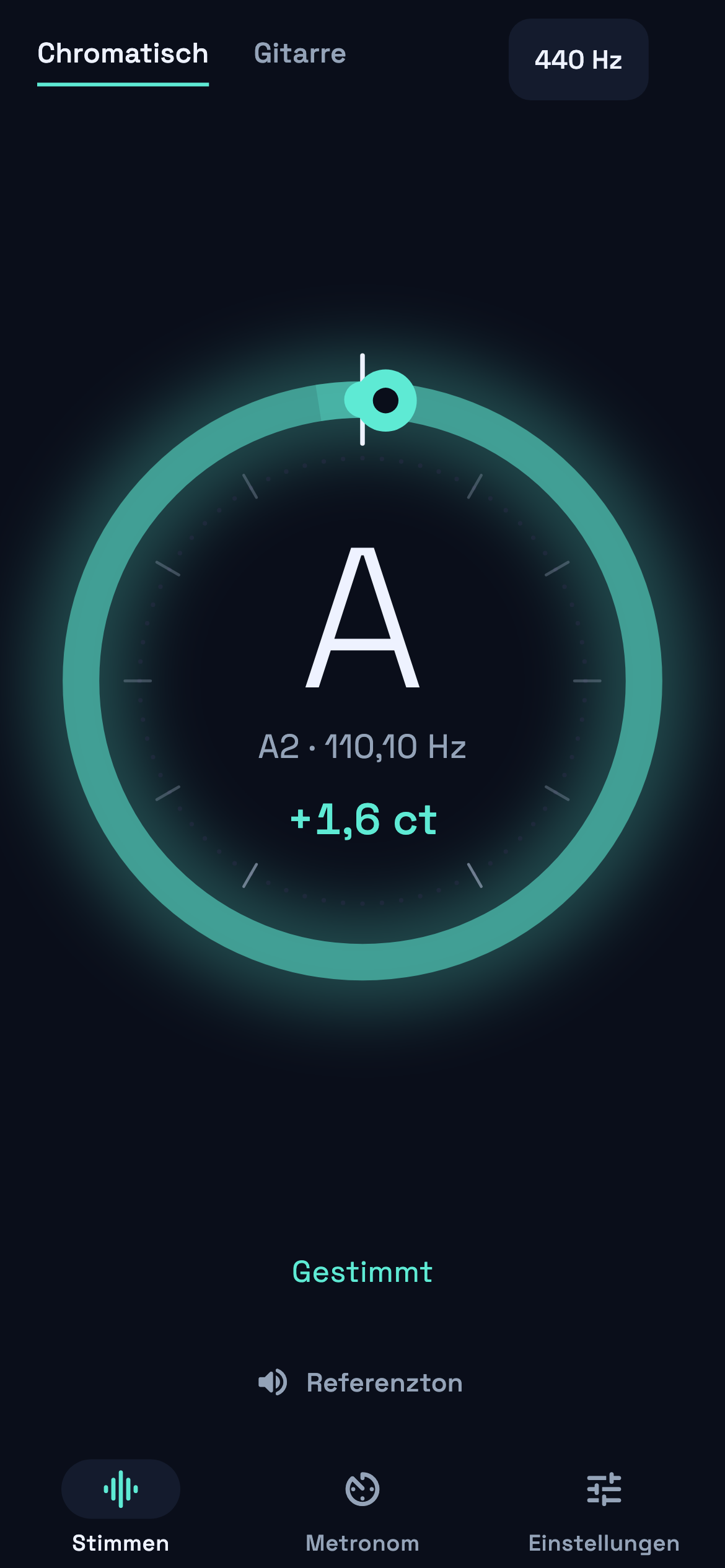
In Chromatic mode (top left), DBX Tuner detects any pitch—ideal for all instruments and vocals.
- In the center are the detected pitch, octave, frequency in Hz, and deviation in cents (100 cents = one semitone).
- The ring shows the deviation: An arc to the right means too high, to the left too low. The mark at the top is the target.
- Colors: Turquoise = in tune, yellow = slightly off, red = significantly off. When the pitch is in tune, the entire ring lights up and the phone vibrates briefly.
- The prompt below the ring tells you what to do, e.g., “Slightly flat · tighten slightly.”
04 Instrument Tuning
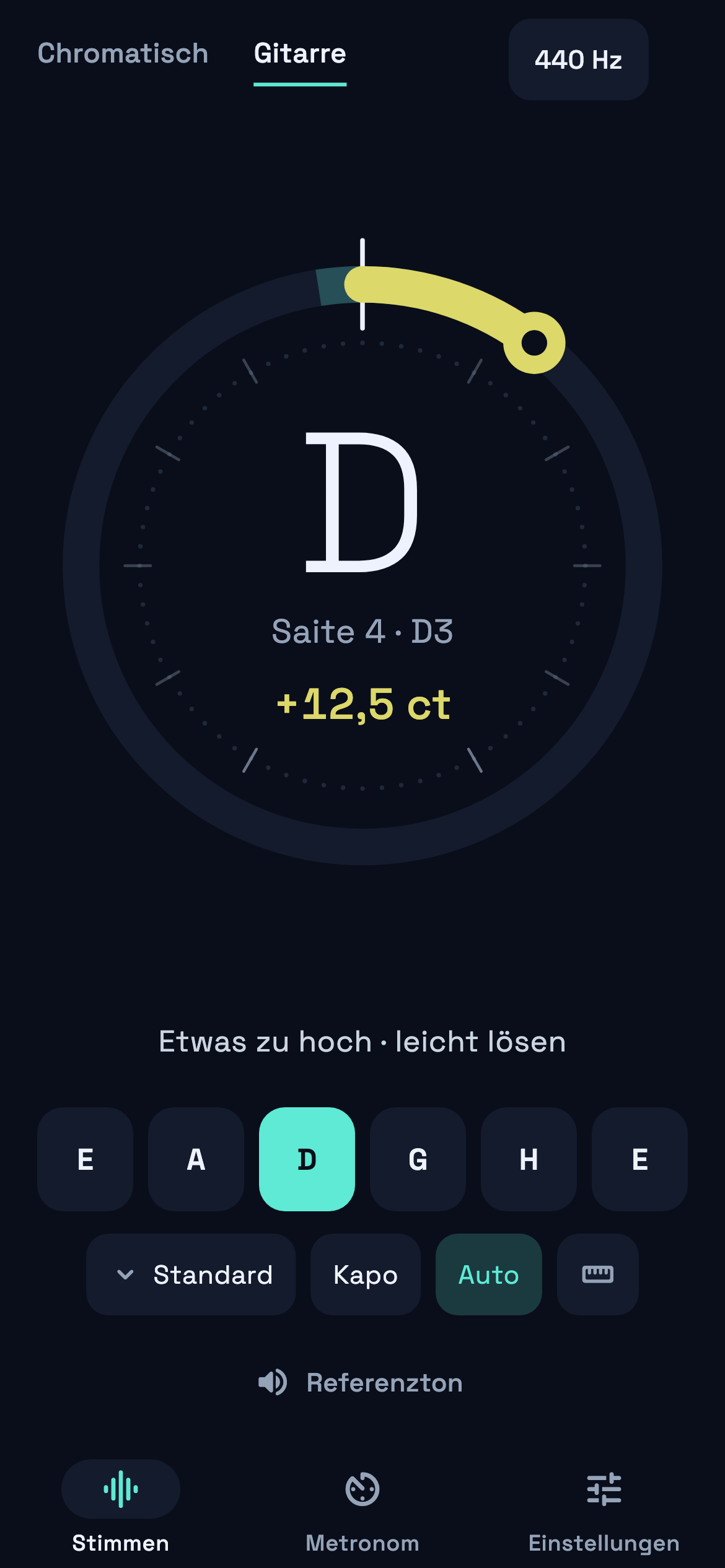
Tap the name of your instrument at the top (e.g., Guitar). The strings appear as tiles at the bottom.
- Auto (enabled): The app automatically detects which string you are playing and highlights it.
- Select a string manually: Tap a string tile. Auto turns off, and the app will only measure against that string—helpful for severely out-of-tune strings.
- Tuned strings are labeled turquoise, so you can see which ones are still missing.
- Select a tuning: Tap the tuning button (e.g., “Standard”). Choose the instrument and tuning: guitar (Standard, Drop D, half-step/whole-step down, DADGAD, Open G/D/E), 4- and 5-string electric bass, ukulele, violin, viola, cello, Bağlama/Saz, and Oud.
- Custom tuning: In the same window, tap “Custom tuning,” enter a name, and adjust each string with − / +. Custom tunings can be deleted using the trash can icon.
- Capo: For guitar, bass, ukulele, and Bağlama, you can set the capo fret. All target pitches shift accordingly.
05 Concert Pitch (Hz)
Tap 440 Hz at the top right to change the concert pitch A4. All pitches are automatically calculated to be correspondingly higher or lower.
- Quick selection: 415 (Baroque), 430 (Classical), 432, 440 (Standard), 442 (Orchestral), 443 (Berlin/Vienna).
- Fine-tune in 0.1 Hz increments with − / + or the slider (400–480 Hz).
06 Reference Tone
Tap Reference Tone to play a tone for tuning by ear. In instrument mode, the selected string sounds (if you change the string, the tone follows); in chromatic mode, the last detected pitch or A sounds. Tap again to stop the tone.
07 Check Octave Purity (Guitar & Bass)
Use the ruler icon in instrument mode to check whether your guitar is perfectly in tune at the 12th fret.
- First, tune the string normally.
- Select the string and play the natural harmonic at the 12th fret until the bar is full.
- Play the fretted note at the 12th fret.
- The app shows the result: If the fretted note is too high, move the string nut slightly away from the neck; if it is too low, move it toward the neck.
08 Metronome
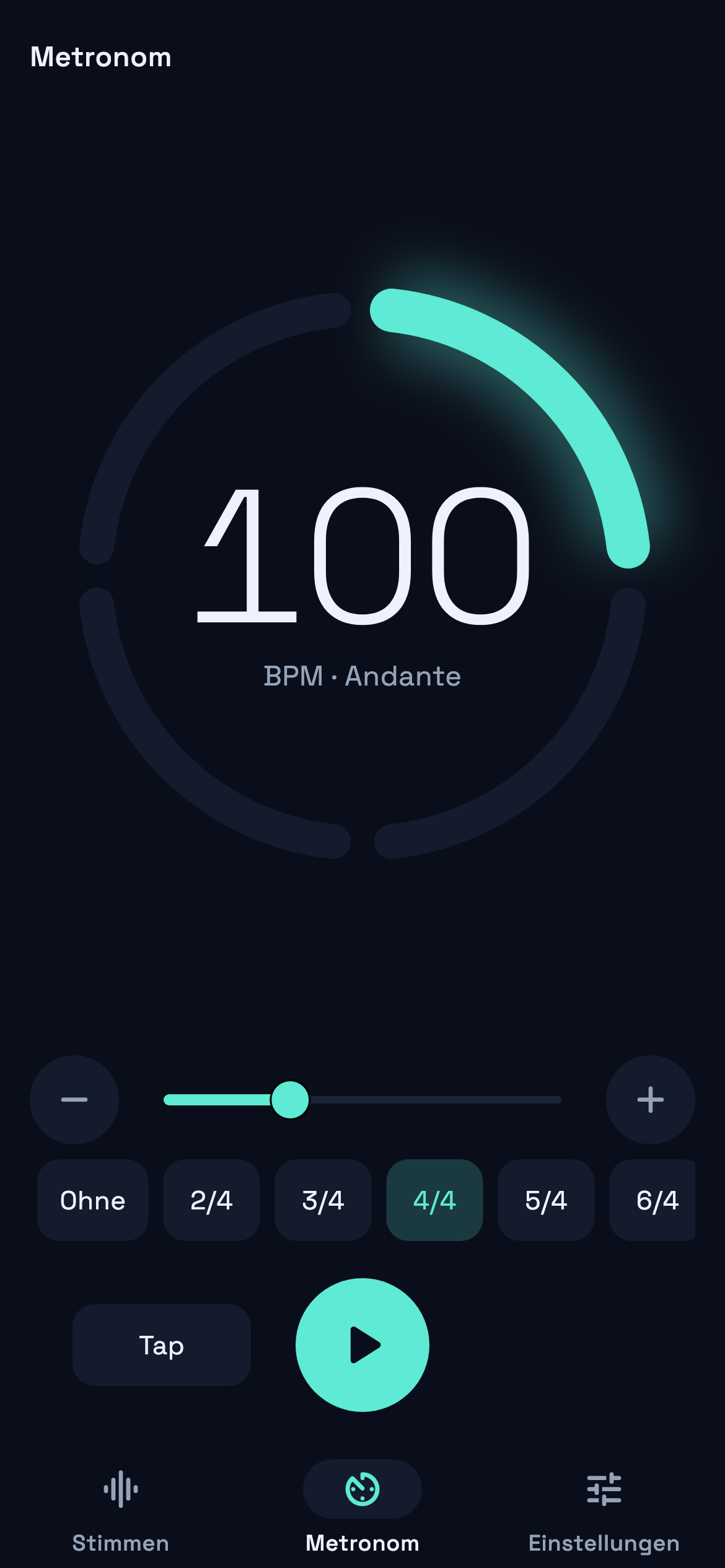
- Tempo: 30–250 BPM using the slider or − / +. The Italian tempo marking (e.g., Andante) is displayed.
- Tap: Tap “Tap” at least twice at the desired tempo.
- Time signature: Without emphasis or 2/4 to 12/4. The first beat is emphasized.
- The ring shows each beat of the measure; the current beat lights up.
- Start and stop using the large round button.
09 Settings
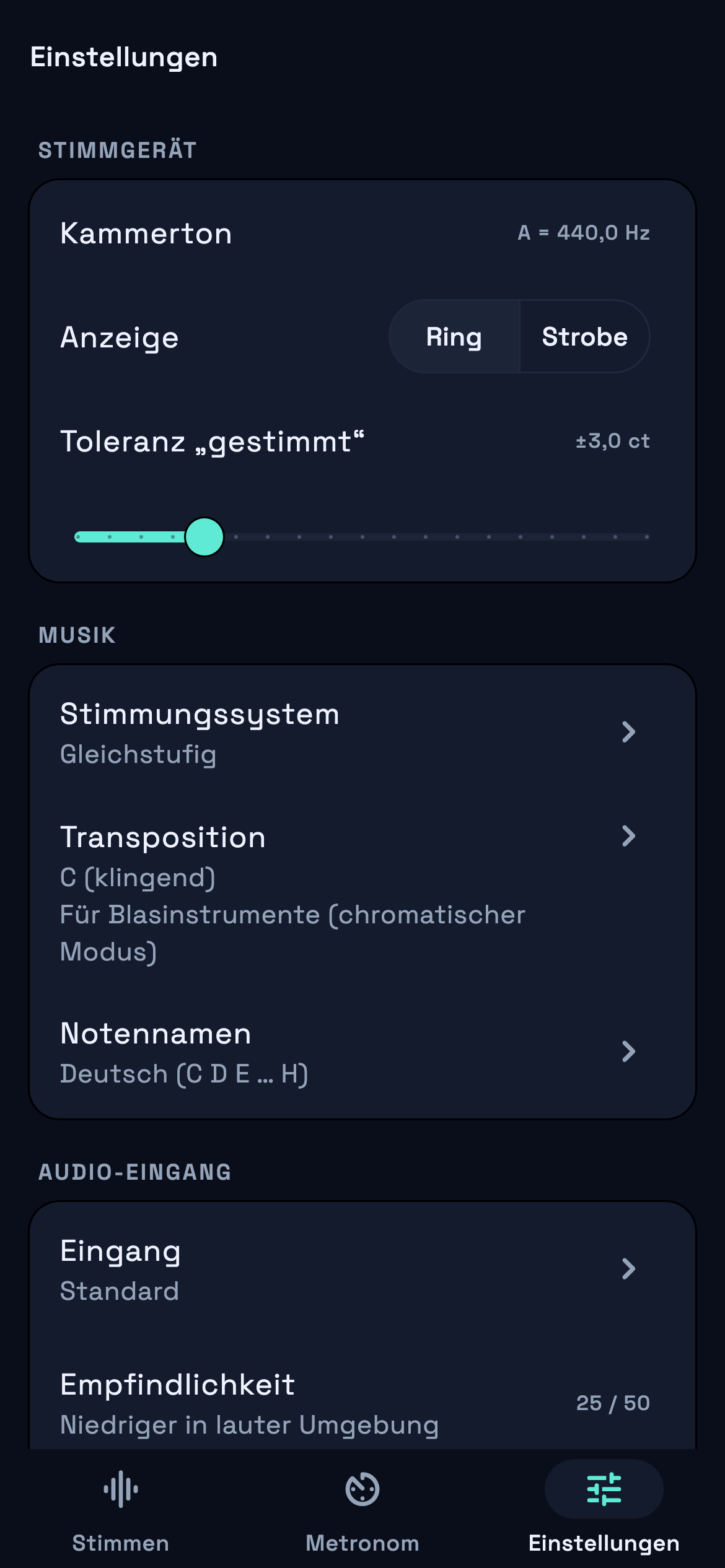
- Display: “Ring” or “Strobe”. In Strobe mode, the bars move to the right if the pitch is too high, to the left if it is too low, and stand still when it is in tune—exceptionally precise.
- “In tune” tolerance: The deviation (±1 to ±10 cents) from which a pitch is considered in tune.
- Tuning system: Equal temperament (Standard), Werckmeister III, mean-tone (¼ comma), just intonation (major) with selectable root pitch, as well as Turkish (53 comma).
- Transposition: For wind instruments in B♭, E♭, F, or G—the app then shows the written pitch instead of the sounding pitch.
- Note names: German (C D E … H), International (C D E … B), or Solfège (Do Re Mi).
- Input: Select a different microphone or audio interface.
- Sensitivity: Lower it in loud environments. The level indicator below shows whether your signal reaches the threshold (line).
- Keep screen on and turn vibration on “in tune” on or off.
- About: Privacy, Legal Notice, Licenses, Version, and Reset (deletes all settings and custom tunings).
10 Turkish System (53 Comma)
For makam music (e.g., Bağlama, Saz, Ney, Kanun), you can select “Turkish (53 Comma)” under Settings › Tuning System. The octave is then divided into 53 commas (Arel-Ezgi-Uzdilek system). In addition to the pitch, the app shows how many commas it deviates from the nearest tonic, e.g., “H −1 comma” (Segâh).
11 Tips & Troubleshooting
- No display: Check microphone permissions (iPhone/iPad: Settings › Privacy & Security › Microphone; Android: Settings › Apps › DBX Tuner › Permissions) and increase the sensitivity.
- Unstable display: Strike the string individually and forcefully, dampen the other strings, and lower the sensitivity in loud environments.
- Wrong string detected: Select the string manually (turn off Auto), especially for severely out-of-tune strings.
- Everything sounds equally “out of tune”: Check concert pitch (440 Hz), tuning system (Equal Temperament), and transposition (C).
- Low pitches (bass): Hold the device closer to the speaker or instrument, or use an audio interface.
12 Privacy
DBX Tuner works completely offline. The microphone signal is only analyzed in RAM and is neither recorded nor transmitted. Only your settings are saved on the device. There are no ads, no tracking, and no account.
Contact & Support
DBX Sound · Owner Deniz Bahadir · Schulstraße 41, 32584 Löhne · info@dbxsound.com · dbxsound.com